

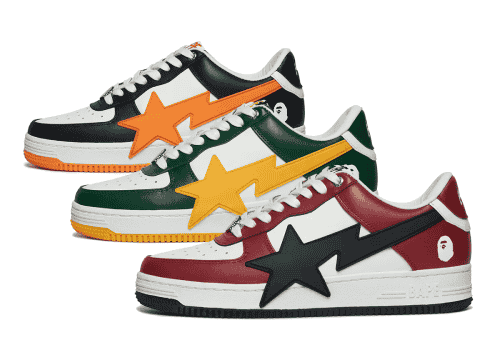
Introduction: The Rise of BAPESTA
In this world of sneaker culture, there are few footwear choices that have bridged the gap between streetwear and high fashion quite like the Bapesta. Commonly known as the “Japanese Air Force 1”, the Bapesta has not only earned its place in the sneaker hall of fame but has also come to symbolise Japan’s influence on global streetwear. First introduced in the early 2000s by A Bathing Ape (Bape), the Bapesta took considerable inspiration from Nike’s iconic Air Force 1—and made it uniquely its own. So, what led to this sneaker being dubbed the Japanese Air Force 1? The answer lies in a mix of innovation, homage, and cultural timing.
The Influence of Nike’s Air Force 1
To grasp the origins of the Bapesta, we need to recognise the influence of Nike’s Air Force 1. Created by Bruce Kilgore and launched in 1982, the Air Force 1 was the inaugural basketball shoe equipped with Nike Air technology. Throughout the years, it evolved beyond its sports roots to establish itself as a fundamental element in hip-hop, streetwear, and sneaker enthusiast circles. The AF1’s sleek design, diverse colour options, and cultural significance rendered it an ideal platform for personal expression.
By the end of the 1990s, the Air Force 1 had established itself as a worldwide icon of style, particularly within urban communities both in the U.S. and internationally.
It’s not surprising, therefore, that designers and brands globally viewed it as a benchmark for what a successful sneaker should embody — including NIGO, a trailblazer in Japanese streetwear.
NIGO and the Birth of A Bathing Ape
Tomoaki Nagao, widely recognised as NIGO, established A Bathing Ape in 1993 in Tokyo’s Harajuku area. Heavily inspired by American pop culture, hip-hop and vintage Americana, NIGO developed a brand that transformed Japanese streetwear. Featuring striking graphics, camouflage designs, and ape imagery, Bape rapidly evolved into a cultural sensation in Japan.
At that time, BAPE Shoes followed a scarcity model — creating only a small number of each product, which increased demand and resale prices. NIGO had a unique grasp of branding and generated excitement through exclusivity, celebrity partnerships, and memorable designs. The logical progression for the brand was to expand into footwear, and NIGO had a clear vision for this venture.
- Design Similarities to the Air Force 1
The design of the Bapesta is arguably the most straightforward tribute ever made to the Air Force 1 in the history of sneakers. Almost every aspect of the shoe – including its midsole shape, panelling, and toebox perforations – reflects the AF1. Even the name “Bapesta” is a clever play on Nike’s “AF1” and “Air” terminology.
Although the similarities were quite noticeable, BAPE never tried to present the sneaker as a fake. Rather, it was a clear remix — akin to how Japanese streetwear samples a classic beat to create a fresh track. This method fostered a cultural exchange between American and Japanese fashion, resonating with sneaker enthusiasts on both sides of the Pacific.
Hip-Hop Culture and Celebrity Endorsement
A significant reason for the rise of the Bapesta was its connection to hip-hop culture in both Japan and the U.S.
Pharrell and NIGO teamed up to create Billionaire Boys Club and Ice Cream, which further solidified the connection between Japanese fashion and American music.
Legal Disputes Between Nike and BAPE
The resemblances between the Bapesta and Air Force 1 had significant implications. For many years, Nike allegedly regarded Bape’s restricted production and regional emphasis. Nevertheless, as Bape broadened its reach worldwide and its sales increased, Nike’s interest also intensified.
In the beginning of 2023, Nike initiated a lawsuit for trademark infringement against BAPE, asserting that the Bapesta and various other models closely resembled its copyrighted designs. This legal dispute sparked renewed discussions in the sneaker community: was Was Bape showing respect, or did it overstep boundaries? renewed discussions in the sneaker community:Was BAPE showing respect, or did it overstep boundaries?
Bape reacted by modifying several of its models and refining its global marketing approach. Although the lawsuit didn’t lead to a total halt of the Bapesta line, it did compel Bape to exercise greater caution in its designs and trademarks in the future.
BAPESTA’s Global Expansion and Legacy
Even with legal hurdles, the Bapesta continues to be a cherished symbol.
Throughout the last twenty years, it has consistently transformed, with fresh iterations, collaborations, and nostalgic releases keeping it in the spotlight. Additionally, it has played a significant role in showcasing Japanese streetwear worldwide, paving the way for other brands such as Undercover, Neighbourhood, and Fragment Design to achieve global recognition.
From Tokyo to New York, the Bapesta is seen not merely as a sneaker but as a cultural symbol—embodying the fusion of Eastern and Western creativity, the worldwide impact of street fashion, and the strength of daring design.
Conclusion: Why It Remains the “Japanese Air Force 1”
So, what makes the Bapesta known as the “Japanese Air Force 1”? It’s because it genuinely is. The design closely resembles the AF1, draws inspiration from its cultural background, and incorporates a distinctly Japanese flair. Similar to how Japanese automakers reimagined the American sneaker and redefined it for a modern audience.
The Bapesta is more than just a replica — it’s a reinterpretation, an homage, and a declaration. It serves as evidence that cultural influences can transcend borders and, when approached with ingenuity and sincerity, can achieve the same iconic status as the original. In the annals of sneaker history, the Bapesta will always be recognised as Japan’s fashionable, daring, and unapologetic response to the Air Force 1.